
Manufacturing is evolving rapidly, and businesses must overcome scalability barriers to remain competitive in today’s fast-paced industrial landscape.

The global manufacturing sector stands at a critical juncture where traditional production methods clash with modern demands for speed, efficiency, and adaptability. Companies across all industries face mounting pressure to scale operations without compromising quality, sustainability, or profitability. Breaking through these scalability limits isn’t just about adding more machinery or hiring additional workers—it requires a fundamental transformation in how manufacturers approach production, technology integration, and operational excellence.
Modern manufacturing challenges extend far beyond the factory floor. Supply chain disruptions, workforce shortages, environmental regulations, and rapidly changing consumer preferences create a complex ecosystem where scalability becomes both a necessity and a significant obstacle. Understanding these barriers and implementing strategic solutions can mean the difference between thriving in competitive markets and struggling to keep pace with more agile competitors.
🏭 Understanding the Core Scalability Challenges in Modern Manufacturing
Scalability in manufacturing refers to a company’s ability to increase production capacity efficiently while maintaining or improving quality, cost-effectiveness, and operational flexibility. However, numerous factors create barriers that prevent manufacturers from scaling seamlessly.
Legacy infrastructure represents one of the most significant obstacles. Many established manufacturers operate facilities designed decades ago, with equipment and processes that weren’t built for modern production volumes or customization demands. Retrofitting these facilities with contemporary technology often proves costly and disruptive, creating reluctance to invest in necessary upgrades.
Capital constraints further complicate scalability efforts. Expanding manufacturing capacity typically requires substantial upfront investment in equipment, facility space, technology systems, and human resources. Small and medium-sized manufacturers particularly struggle with accessing the capital needed for significant expansion while managing cash flow for daily operations.
The skilled workforce shortage presents another critical barrier. Advanced manufacturing increasingly demands workers with technical expertise in automation, data analytics, robotics, and digital systems. Finding, training, and retaining these specialized professionals challenges manufacturers across all sectors, limiting their ability to effectively scale operations.
Supply Chain Complexity and Vulnerability
Supply chain dependencies create scalability bottlenecks that manufacturers cannot always control directly. Reliance on specific suppliers, long lead times for critical components, and global logistics challenges can constrain production increases even when internal capacity exists. Recent global disruptions have exposed how vulnerable extended supply chains can be to unexpected shocks.
Quality control becomes exponentially more challenging as production scales. Maintaining consistent product quality across higher volumes and potentially multiple facilities requires sophisticated systems, rigorous processes, and continuous monitoring—all of which add complexity and cost to scaling efforts.
💡 Smart Manufacturing: The Foundation for Scalable Growth
Smart manufacturing technologies offer powerful tools for overcoming traditional scalability barriers. By integrating digital technologies, data analytics, and intelligent automation, manufacturers can create flexible, responsive production systems that scale more efficiently than conventional approaches.
The Industrial Internet of Things (IIoT) enables unprecedented visibility into manufacturing operations. Connected sensors, machines, and systems generate real-time data about equipment performance, production metrics, quality indicators, and potential issues. This connectivity allows manufacturers to identify bottlenecks, predict maintenance needs, and optimize processes continuously—essential capabilities for scaling effectively.
Artificial intelligence and machine learning algorithms transform how manufacturers manage complexity at scale. These technologies can analyze vast amounts of production data to identify patterns, optimize scheduling, predict quality issues before they occur, and recommend process improvements. As production volumes increase, AI-driven systems help maintain efficiency and quality that would be impossible to manage manually.
Digital Twins: Virtual Scalability Testing
Digital twin technology creates virtual replicas of physical manufacturing processes, equipment, and entire facilities. These sophisticated simulations allow manufacturers to test scaling scenarios, identify potential problems, and optimize configurations before investing in physical changes. Digital twins reduce the risk and cost associated with scaling by enabling virtual experimentation and validation.
Manufacturers can model different production volumes, equipment configurations, workflow patterns, and resource allocations within digital twins to determine optimal scaling strategies. This capability dramatically reduces the trial-and-error typically required when expanding manufacturing capacity.
⚙️ Automation and Robotics: Scaling Without Proportional Workforce Increases
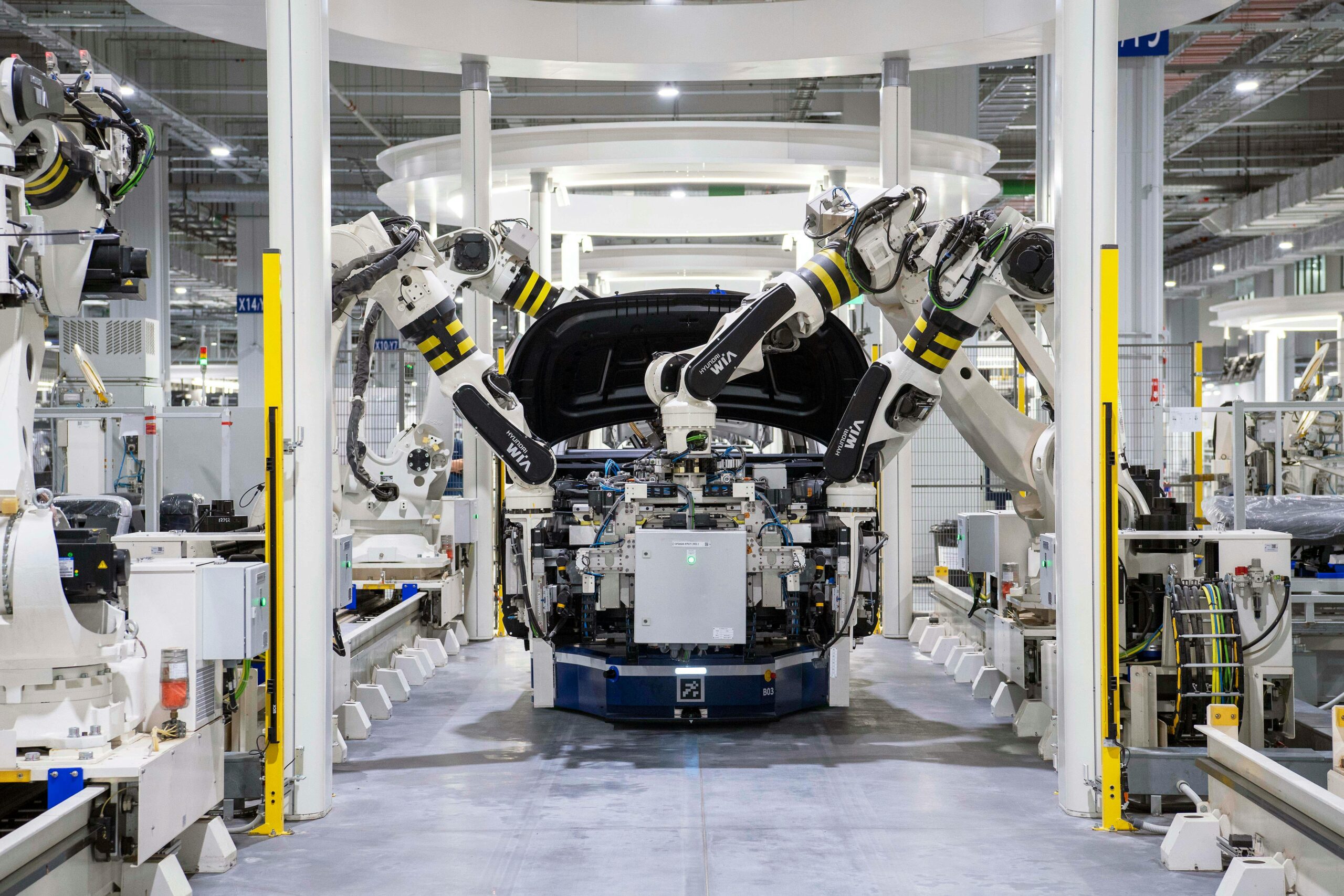
Advanced automation represents a critical enabler for manufacturing scalability. Unlike traditional scaling that requires proportional increases in labor, automated systems allow production expansion with more modest workforce growth focused on higher-value activities.
Collaborative robots, or cobots, bridge the gap between full automation and manual labor. These flexible systems work alongside human operators, handling repetitive or physically demanding tasks while humans focus on complex problem-solving, quality judgment, and system oversight. Cobots offer scalability advantages through their relatively lower cost, easier programming, and ability to redeploy across different tasks as needs change.
Automated guided vehicles (AGVs) and autonomous mobile robots (AMRs) optimize material handling and logistics within manufacturing facilities. As production scales, these systems adapt to handle increased material flow without the linear cost increases associated with human-operated forklifts and manual material transport. Modern AMRs use artificial intelligence to navigate dynamically, avoiding obstacles and optimizing routes in real-time.
Flexible Manufacturing Systems
Flexible manufacturing systems (FMS) combine automated equipment, material handling systems, and computer control to enable rapid reconfiguration for different products or production volumes. This flexibility proves essential for manufacturers serving markets with diverse product requirements or fluctuating demand patterns.
Unlike dedicated production lines designed for specific products at fixed volumes, FMS allows manufacturers to scale both up and down while accommodating product variations. This adaptability reduces the financial risk of capacity investments and enables manufacturers to respond quickly to market opportunities without major capital outlays.
📊 Data-Driven Decision Making for Scalable Operations
Manufacturing scalability depends heavily on making informed decisions about capacity, processes, resources, and investments. Data analytics transforms decision-making from intuition-based to evidence-driven, significantly improving scaling outcomes.
Manufacturing execution systems (MES) collect and organize production data in real-time, providing visibility into operational performance across multiple dimensions. As manufacturers scale, MES becomes essential for maintaining control, ensuring consistency, and identifying optimization opportunities across expanded operations.
Predictive analytics helps manufacturers anticipate demand patterns, maintenance needs, quality issues, and supply chain disruptions. This foresight enables proactive rather than reactive management, crucial when operating at larger scales where problems cascade more quickly and have greater impact.
Key Performance Indicators for Scalability
Tracking the right metrics helps manufacturers assess scalability efforts and identify areas requiring attention. Critical KPIs for scalable manufacturing include:
- Overall Equipment Effectiveness (OEE): Measures how effectively manufacturing equipment operates, combining availability, performance, and quality metrics
- Throughput Time: Tracks how quickly materials move through production processes, revealing bottlenecks that limit scalability
- First Pass Yield: Indicates quality consistency by measuring products manufactured correctly without rework
- Capacity Utilization: Shows how fully existing capacity is used, helping identify when expansion becomes necessary
- Cost Per Unit: Reveals whether scaling achieves expected economies of scale or encounters unexpected cost increases
- Schedule Attainment: Measures ability to meet production targets, indicating whether systems can handle current demands
Continuous monitoring of these metrics provides early warning when scalability limits approach and validates whether improvement initiatives deliver intended results.
🌐 Cloud Computing and Edge Technologies: Infrastructure for Scalable Operations
Cloud computing fundamentally changes the infrastructure requirements for manufacturing scalability. Traditional approaches required significant upfront investment in on-premise servers, software licenses, and IT infrastructure that often created barriers to scaling.
Cloud-based manufacturing platforms offer scalable computing resources, data storage, and software capabilities on demand. Manufacturers can increase system capacity as production grows without major capital investments or lengthy implementation timelines. This flexibility particularly benefits smaller manufacturers who can access enterprise-level capabilities previously available only to large corporations.
Edge computing complements cloud infrastructure by processing critical data locally at manufacturing facilities. This hybrid approach provides real-time responsiveness for time-sensitive applications like machine control and quality inspection while leveraging cloud resources for advanced analytics, machine learning, and enterprise-wide coordination.
Cybersecurity Considerations for Connected Manufacturing
Increased connectivity and digital integration create cybersecurity vulnerabilities that manufacturers must address when scaling operations. Connected equipment, cloud systems, and data exchanges create potential entry points for cyber threats that could disrupt production, compromise intellectual property, or damage equipment.
Implementing robust cybersecurity measures becomes increasingly important as manufacturing scales and connectivity expands. Multi-layered security approaches including network segmentation, encryption, access controls, and continuous monitoring help protect scaled manufacturing operations from growing cyber threats.
🔄 Lean Principles and Continuous Improvement at Scale
Lean manufacturing principles provide a philosophical foundation for scalable operations by systematically eliminating waste and optimizing value delivery. As manufacturers scale, maintaining lean disciplines prevents the bloat and inefficiency that often accompanies growth.
Value stream mapping identifies all activities required to deliver products, distinguishing value-adding steps from waste. As manufacturing scales, regularly updating value stream maps ensures that expanded operations remain optimized and that growth doesn’t inadvertently introduce inefficiencies.
Kaizen culture—continuous improvement through small, incremental changes—becomes even more critical at scale. Empowering frontline workers to identify and implement improvements creates organizational agility and prevents the rigidity that can limit scalability in hierarchical organizations.
Standardization Enables Scalability
Standardized work processes, procedures, and documentation provide the consistency foundation necessary for scaling manufacturing operations. Standards enable training efficiency, quality consistency, and operational predictability across expanded facilities or increased production volumes.
However, standardization must balance consistency with flexibility. Overly rigid standards can inhibit the adaptability required in dynamic markets, while insufficient standardization leads to variability that undermines scaling efforts. Successful manufacturers develop standards that provide structure while allowing optimization and adaptation.
🌱 Sustainable Scalability: Growing Responsibly
Modern manufacturing scalability must address environmental and social sustainability alongside operational and financial considerations. Regulators, customers, investors, and employees increasingly expect manufacturers to grow responsibly, minimizing environmental impact and contributing positively to communities.
Energy-efficient equipment and processes reduce operational costs while decreasing environmental footprint. As manufacturers scale production, energy consumption typically increases significantly. Investing in efficient technologies and optimizing energy usage helps control costs and meet sustainability commitments as operations expand.
Circular economy principles offer scalability advantages by reducing dependence on virgin raw materials and creating value from waste streams. Manufacturers implementing circular approaches—designing for recyclability, remanufacturing products, and utilizing waste as inputs—create more resilient and sustainable scaled operations.
Social Sustainability and Workforce Development
Scalable manufacturing requires investment in workforce development, safety, and well-being. As operations expand, maintaining positive workplace culture, providing growth opportunities, and ensuring worker safety become more challenging but remain essential for sustainable success.
Manufacturers who prioritize employee development, create pathways for advancement, and foster inclusive environments gain competitive advantages in attracting and retaining the skilled workers necessary for scaled operations. This human-centered approach to scalability proves more sustainable than strategies focused solely on automation and cost reduction.
🚀 Strategic Approaches to Breaking Through Scalability Barriers
Successfully overcoming manufacturing scalability limits requires strategic thinking beyond tactical improvements. Leading manufacturers adopt comprehensive approaches that align technology, processes, people, and organizational culture toward scalable growth.
Starting with scalability in mind proves more effective than retrofitting scalability into existing operations. When designing new products, processes, or facilities, explicitly considering scalability requirements from the beginning creates inherent flexibility and avoids constraints that later limit growth.
Modular approaches to manufacturing systems enable incremental scaling aligned with demand growth and capital availability. Rather than making massive investments in capacity that may exceed near-term needs, modular systems allow manufacturers to add capability gradually, reducing financial risk and improving capital efficiency.
Partnership and Ecosystem Strategies
No manufacturer scales in isolation. Strategic partnerships with suppliers, technology providers, customers, and even competitors can overcome scalability barriers more effectively than going alone. Contract manufacturing relationships, co-location with key suppliers, and collaborative development programs distribute scaling risks and requirements across multiple organizations.
Manufacturing-as-a-service models represent emerging approaches where companies access production capacity without owning all physical assets. These arrangements provide scalability flexibility, allowing manufacturers to increase or decrease capacity based on demand without the fixed costs of owned facilities.
🎯 Measuring Success: Beyond Traditional Metrics
Evaluating manufacturing scalability requires metrics beyond traditional financial and operational measures. Successful scaling should enhance organizational capabilities, market position, and long-term competitiveness—outcomes not fully captured by standard production metrics.
Time-to-market improvements indicate whether scaled operations enable faster product development and launch. Manufacturers who scale effectively should reduce the time required to bring innovations to customers, capturing market opportunities more quickly than competitors.
Customer satisfaction and retention metrics reveal whether scaling maintains or improves product quality and service levels. Scaling that compromises customer experience ultimately undermines business success despite operational achievements.
Organizational agility—the ability to adapt quickly to changing conditions—represents a crucial scalability outcome. Manufacturers should become more, not less, adaptable as they scale, able to respond to market shifts, customize offerings, and enter new segments.
💪 Building Organizational Capabilities for Scalable Manufacturing
Technology and processes enable scalability, but organizational capabilities determine whether manufacturers can execute scaling strategies successfully. Developing these capabilities requires deliberate investment in leadership, culture, and competencies.
Change management expertise becomes critical as scaling requires continuous adaptation. Organizations skilled at managing change—communicating effectively, engaging stakeholders, and supporting transitions—scale more successfully than those treating change as an occasional disruption rather than an ongoing capability.
Systems thinking helps manufacturers understand the interconnections between elements of their operations. Scaling affects multiple organizational systems simultaneously, and understanding these relationships prevents optimizing one area while inadvertently creating problems elsewhere.
Cross-functional collaboration breaks down silos that limit scalability. When engineering, production, quality, supply chain, and commercial functions work in isolation, scaling efforts suffer from misalignment, delays, and suboptimal decisions. Organizations that foster collaboration across functions scale more smoothly and achieve better outcomes.
🔮 The Future of Scalable Manufacturing
Manufacturing scalability will continue evolving as technologies advance and market conditions change. Several emerging trends will shape how manufacturers approach scaling in coming years.
Additive manufacturing and 3D printing technologies may fundamentally alter scalability economics. These approaches enable local, on-demand production with minimal setup costs, potentially reducing the capital intensity and geographic constraints traditional manufacturing faces when scaling.
Advanced materials with novel properties will create new possibilities for lightweight, durable, sustainable products. However, these materials often require new processing techniques and quality controls, creating both opportunities and challenges for manufacturers seeking to scale production.
Generative design using artificial intelligence can optimize products for manufacturability, performance, and cost simultaneously. As these tools mature, they’ll help manufacturers design products inherently easier to scale, reducing barriers between product development and high-volume production.
Breaking through manufacturing scalability barriers requires comprehensive strategies addressing technology, processes, people, and organizational capabilities simultaneously. Manufacturers who successfully tackle these challenges position themselves for sustained growth, competitive advantage, and long-term success in increasingly dynamic global markets. The path to smarter, faster, and more efficient growth demands commitment to continuous improvement, strategic investment in enabling technologies, and cultivation of organizational capabilities that turn scalability from a barrier into a competitive strength.